Monday

Barbecue Shrimp, New Orleans Style

Curious name, as it's cooked on a stove, not outside over charcoal. But definitely one of NOLA's signature dishes, consisting of tender, sweet shrimp cooked in a richly reduced buttery sauce. I looked at several recipes, all confirming they were mostly variants of the same thing. However I made several tweaks.

First, clam juice was out. Since I was cooking shrimp that I'd peel, shrimp stock was in. I peeled the 1# of jumbo shrimp I bought and boiled the shells and legs with a couple of cups of water. After thirty minutes, I strained out the shells and then further boiled the two cups of shrimp stock down to one flavorful cup.

Next, garlic powder? Onion powder? Not even sure I know what these are. To beef up the heat and flavor I finely chopped a big garlic clove and added it to my shrimp marinade. I had a couple of green onions so I sliced them up and added them too.

Finally: Cajun seasoning is basically salt, pepper, cayenne pepper, paprika and dried herbs, so I assembled my own to marinate the shrimp in-- adding freshly chopped garlic and lots of freshly ground pepper. I used smoked, not hot, paprika. Also a little tumeric, as I like the color and it's allegedly good for your aching joints.

That is more or less it. The recipe below provided the template. I marinated the shrimp for about 5 hours and there was plenty of flavor. I also halved the recipe, and there are leftovers. Instead of the traditional rice, I served it with polenta. I'd seen Jacques Pepin preparing it the night before on TV and I'm so bloody suggestible...

This was delicious: mildly spicy, slightly acidic, but packed with fresh shellfish flavor, rich, and umami-ish.

INGREDIENTS
    • 2 pounds large shrimp, peeled and deveined
    • 2 tablespoons Cajun seasoning
    • 2 tablespoons canola oil
    • 6 cloves garlic, smashed and peeled
    • One 12-ounce light-bodied beer
    • Juice of 1 lemon
    • One 8-ounce bottle clam juice
    • 1/4 cup hot sauce, preferably Tabasco
    • 1/4 cup Worcestershire sauce
    • 2 tablespoons apple-cider vinegar
    • 2 dried bay leaves
    • 1 teaspoon whole black peppercorns
    • 1/2 cup (1 stick) cold butter, cut into cubes
    • 1 crusty French baguette

PREPARATION

  • Toss the shrimp with the Cajun seasoning in a medium bowl. Set aside.
  • Heat the canola oil in a large saucepan over medium-high heat. Once it's hot, toss in the garlic, and sauté until golden, about 3 or 4 minutes. Add the shrimp to the pan, and cook until they turn bright pink, about 1 minute more. Remove the shrimp from the pan with a slotted spoon, and set aside on a plate. Pour in the beer, lemon juice, clam juice, hot sauce, Worcestershire sauce, apple-cider vinegar, bay leaves, and peppercorns; bring to a simmer, and cook for 15 minutes, until the liquid is slightly thickened.
  • Whisk the cubes of butter into the sauce, and once it's melted, add the shrimp to finish cooking, about 2 minutes more. Serve the shrimp and sauce in bowls with loads of crusty bread for dipping, or over rice or be like Darly and use polenta. 

Saturday

New Summer Staple: Thai Beef Salad

I think this will be a new summer staple at chez nous.

Three slices charred but still rare flank steak, seasoned with a suggestion of ginger, hot peppers and lemongrass, its beefiness heightened with a touch of fish sauce, its richness balanced by a spritz of lime juice.

THAI-STYLE MARINATED FLANK STEAK AND HERB SALAD

For the Marinade
1/2 cup palm sugar or brown sugar
1/4 cup water
3 tablespoons fish sauce
1/3 cup lime juice
2 cloves garlic, grated on a microplane zester
1 tablespoon Thai red curry paste 
1/4 cup vegetable oil
1 whole flank steak, about 2 pounds

For the Salad
Mesclun mix
mint leaves
cilantro leaves
chives, cut into 1 1/2-inch segments
basil leaves


I used a much smaller piece of beef leftover from another recipe and cut back on the marinade accordingly. 

1
Combine water and sugar in a small saucepan and heat over medium heat until completely dissolved. Transfer to a small bowl, add fish sauce, lime juice, garlic, and chili powder and stir to combine. Transfer half to a small container and reserve until step 3. Add oil to remaining half and whisk to combine. Place flank steak inside a gallon-sized zipper-lock bag with marinade. Press out air, seal bag, and allow meat to marinate, turning occasionally, for at least 1 hour and up to 12.

2
Remove steak from marinade and pat dry with paper towels. Ignite a large chimney full of coals and wait until they're covered in grey ash. Spread evenly over 1/2 of grate, leaving the other half empty. Put the cooking grate in place, cover, and allow grill to preheat for 5 minutes. Scrape cooking grates clean, then place flank steak over hot side of grill. cook until well charred, about 3 minutes. Flip steak and continue to cook until second side is well charred, about 3 minutes longer. Transfer steak to cooler side of grill, cover, and cook until the center of the steak registers 125°F on an intant-read thermometer for medium-rare, or 135° for medium, about 5 minutes longer. Transfer to a cutting board, tent with foil, and allow steak to rest for at least 5 minutes.

3
Dress salad with a little vinagraitte and leftover marinade to taste. 

4. Slice the beef-- against the grain-- thinly. Plate the salad. Drap a few slices of beef atop the salad. Add a wedge of lime. Pop open a cold beer. 


Tuesday

Bolognese

So many variations. All intensely satisfying. Time consuming: yes. Difficult: I don't think so.

Bacon

Onion, carrot, celery

Skirt steak, chicken thighs

Tomato paste, garlic

Wine (white, red, or both)

Milk

Stock

1. Chop up two or three strips of bacon and sauté to render out the fat, 5 minutes or so. Remove bacon with slotted spoon, leaving fat in the pan. While that's happening:

2. Finely dice an onion, a stalk of celery and a carrot. Saute these in the bacon fat over medium heat-- lowering it as they give up their water-- for about 10 minutes. Remove from pan. While that's happening:

3. Take your pound, pound and a half, of skirt steak and chop it as finely as possible. Cut the meat into matchsticks first, then line a few of them up and cut them across into a dice of about 1/4 inch. Do the same with two chicken thighs. (Or substitute some veal, or some pork shoulder or belly.) Salt and pepper the meat, then:

4. In same pan, add 3 tbls of olive oil and add the chopped meat and sauté until cooked through, about 3 minutes.

5. Add two tbls of tomato paste and stir it around the meat, cooking for about 1 minute.

6. Add 1/2 cup wine to pan and let it sizzle up, give up steam. Stir it until it evaporates, about 2 minutes.

7. Add 1/2 cup milk to the pan and do same.

8. Add a couple of finely chopped garlic cloves, a bit more salt and some freshly ground black pepper, and if you have it, a fine scraping of nutmeg-- but very, very little. Put the cooked bacon and vegetables back in.

9. I add more tomato here-- a can of good tomatoes, or, as I had some in the freezer, some homemade tomato sauce. About two cups. Let it cook down.

10. Start adding stock by the ladleful. I used chicken. But any would work. Also water would work.

11. Keep cooking, simmering, allowing the liquid to evaporate, building it back up. It'll thicken and richen. After about an hour, you'll have a thick, meaty delicious sauce.

Some people will finish this with a little heavy cream. I don't think it needs it. But a tablespoon or two of butter is nice.

Put this on fresh tagliatelle or papparadelle pasta. You don't need a lot. Fresh Parmesan is a must.

Thursday

Eleven, and a little dining history

Pittsburgh dining was pretty grim for a very long time, comprised of tried and true Italian-American restaurants, average Chinese, and Eat 'N Parks. Even the well-off were limited to the stuffy, predictable charms of Christopher's on Mt. Washington, Top of the Triangle downtown, or the Park Schenley (where I worked as a waiter one summer in 1984, just before it wheezed its last gasp and expired) in Oakland.


But slowly appearing where real dining gems: Le Petit Cafe in Shadyside; the Carlton downtown; and Cafe Allegro and Le Pommier in the South Side, restaurants that offered items that were unlike any many of us had seen before. The grilled octopus at Cafe Allegro was a particular standout.
After reading that Chi-Chi's had been voted "Best Mexican Restaurant" in Pittsburgh Magazine, a couple of local entrepreneurs decided they could do better and opened Mad Mex. It was loud, crowded, colorful, and it had personality-- a funny, unique identity created by marketing geniuses Bernard Uy and James Nesbitt of Wall-to-Wall Studios (where I eventually also worked, in business development).

Mad Mex flourished and eventually led to Kaya, Vertigo (since closed), Soba, Casbah, and Eleven, the restaurants that comprise the big Burrito Restaurant Group. Suddenly, Pittsburgh was a viable dining town-- or at least leaning towards becoming one.

Pittsburgh's always been a good eating town: bacon cheeseburgers at Squirrel Hill Cafe; Lucy's banh mi in the Strip; Aiello's pizza in Squirrel Hill... but I would argue that until the arrival of this second wave group of restaurants in the late 1980s and early 1990s it was not a good dining town-- a place where you could relax over a meal you'd be unlikely to recreate at home, courses properly coursed, unrushed, delicious, a temporary reprieve from life's stresses... a small vacation that left you refreshed.

Now, the third wave of great dining opportunities has arrived: Salt of the Earth; Legume; Stagioni; Sienna; Cure; Root 174-- and the greatly missed Bona Terra.

But at the top of the list, for my money, is Eleven, where wifey and I enjoyed a superb meal last Saturday. Everything about the meal was perfect, from the greeting to the good-bye.

Our oysters were small yet plump, sweet yet briny, perfect with a glass of Carneros blanc de noir. Each were delicious on their own or dressed with the classic mignonette sauce or the habanero-based cocktail sauce (of which a little goes a long way).

Susan started with lamb Carpaccio, delicate, scented with coriander, dressed with miso-- it was toothsome but light, the earthy richness an easy foil for our Roussillon white wine. My tuna tartar was cool and refreshing, with hints of preserved lemon and occasional shards of shallot which added a bright line of treble to the finely diced flesh; a bass note came courtesy of briny white anchovies that formed an "X" on top of the perfect circle of tartar.

Susan's halibut swam in a sea of roasted seasonal vegetables: peas, grilled radicchio, beets and radishes... my two lamb loin chops were a perfect medium rare, served atop buttery polenta with roasted Brussel sprouts, dark olives, and a rich, deep demi-glace.

The sorbets refreshed, the cannoli comforted.

Our table was dimly lit and romantic. The service was gracious, attentive without being intrusive, the server informed and possessed of perfect timing.
Eleven may not be the newest, but it is a place where everything comes together with perfect execution.
And did I mention the dollar oysters in the bar during happy hour?

Sunday

New cocktail, needs a name

Wifey bought some cherry juice from Trader Joe's but didn't fancy it. I put on my cocktail hat and thought about putting it to good use.

First it would need to be reduced, otherwise it might as well be cranberry. So I boiled a cup of it down to 1/4 cup, along with a dozen black pepper seeds.

Being winter I thought whiskey base. I scanned the bar and saw sweet vermouth, bitters, Grand Marnier... for some reason I thought of maple syrup for the sweetener. To build it, I was thinking Sazerac. Here's what happened:


  • Chill a tumbler with ice.


  • Over ice combine: 
- Measure of whiskey (I used Canadian)

- 1/4 measure sweet vermouth
- Bar spoon of reduced cherry juice
- Bar spoon of maple syrup
- Big dash orange bitters (or Angostura, if you want more spice)


  • Stir.


  • Empty tumbler, rinse the chilled glass with a bar spoon of Grand Marnier, coating the sides of the glass well. 


  • Strain in the drink. Garnish with a wide swath of orange peel, first twisting it over the cocktail.


It's very tasty, and you can enjoy the interplay of cherry and whiskey. Perhaps bourbon might work better than Canadian... and perhaps a hint of lemon might brighten it a little. But I love orange twists on cold nights, and this is mos' def' a cold night warmer.

Suggestions to improve?

Suggestions for a name?

Cheers.


Thursday

Short Rib Chili

I rely on the New York Times for sage food advice, especially from Melissa Clark and Mark Bitman (whose "How to Cook Everything" is disintegrating in my kitchen from use). Recently Ms. Clark posted a vid/recipe for short rib chili. I love chili, including the basic ground beef and pinto beans version, but this particularly meaty, bean-free recipe caught my attention.

My friend Chef Bill Fuller once dubbed chili "America's curry," meaning it is both endlessly adaptable and has developed unique regional differences over time, like India's curries. (According to the author David Burton, of the excellent The Raj at Table, "chili powder"-- the mix of cumin, dried peppers, and onion powder, which your mom bought in small plastic jars to season ground beef-- was invented by an Indian-raised Englishman in Mexico who was homesick for the flavors of his youth.)

An inveterate tinkerer, I had to adapt Ms. Clark's recipe, chiefly by adding a puree of toasted whole dried chilis, and adding about a cup of cooked cranberry beans. The result was earthy, meaty, smoky, spicy, and entirely satisfying.

Here's her recipe, my additions in bold:

 Ingredients


4 pounds bone-in beef short ribs, patted dry (I used about 2 pounds, which was ample; I also very lightly floured the beef prior to browning them)

5 teaspoons coarse kosher salt, more to taste

1 1/2 teaspoons black pepper

5 garlic cloves, smashed and peeled

2 jalapeño or serrano peppers, halved lengthwise, seeded if desired (I used one)

1 onion, peeled and quartered lengthwise

1 (28-ounce) can chopped tomatoes

1/2 cup coarsely chopped cilantro stems, and 1/4 cup chopped leaves

2 teaspoons dried oregano

2 tablespoons extra-virgin olive oil

1 to 2 tablespoons chile powder, to taste

2 teaspoons ground cumin

2 teaspoons ground coriander (I left this out, but added a tablespoon of tumeric)

1 tablespoon tomato paste

1 (12-ounce) bottle Mexican lager, like Negra Modelo (I used Great Lakes Brewing lager)

A dried Chipotle pepper

A dried Poblano pepper

A Chipotle pepper from a can of Chipotles in Adobo sauce


1.Heat oven to 325 degrees. Season short ribs with 3 teaspoons salt and the black pepper. Let rest while you prepare sauce.

2.Place a large, dry Dutch oven over high heat. Add garlic, peppers and onion to the dry pan. Cook, turning occasionally, until lightly charred all over, about 10 minutes. I added a dried poblano and a dried chipotle pepper to the pan.

3.Transfer garlic, peppers and onion to a blender. Add tomatoes with juice, cilantro stems, oregano and 1 teaspoon salt. Purée until smooth. Place the toasted dried peppers in a bowl and cover with about a cup of boiling water and let soften for 10-15 minutes. Deseed and devein the soaked peppers (or leave seeds and veins in for more heat). Puree the peppers with two cloves of smashed garlic, half a canned chipotle with some of its adobo sauce, some oregano, salt and pepper and some of the soaking liquid to make a paste. Set aside.


4.Return Dutch oven to medium-high heat. Add olive oil. Sear short ribs in batches, until well-browned all over, about 20 minutes. Transfer browned ribs to a bowl. Finely chop a medium onion, stalk of celery and carrot and sautee in Dutch oven til soft, about 10 minutes.

5.Stir dried spices into pot and cook until fragrant, about 30 seconds. Stir in tomato paste and cook until it begins to caramelize, 1 to 2 minutes. Add purreed dried peppers to taste to the vegetable puree; I used about half. Stir for about a minute. Stir in tomato-pepper purée and beer and bring to a simmer. Return short ribs to pot, cover and transfer to oven. Bake for 1 1/2 hours, then uncover pot, give meat a stir, and continue baking until ribs are fork tender and falling off bone, 30 to 45 minutes longer, for a total cooking time of 2 to 2 1/4 hours. (If you have time, let short ribs mixture cool, refrigerate overnight, then remove fat before proceeding.)

6.Once ribs are cool enough to handle, remove from pot, reserving sauce. Shred meat and discard bones and gristle. If sauce seems thin, simmer on stove until it thickens enough to coat a wooden spoon. Return meat to pot.

Ms Clark severed them atop tortilla chips with melted cheese, salsa, sour cream and guacamole-- nachos. I'm sure they'd be excellent, but I served it as a hot dog topping one night and just as stand alone chili the next-- on rice, with a little grated cheddar. It was superb, especially on a cold, snowy evening.

Tuesday

Broccoli Stems

Once you peel the tough outer layer, the stem is tender and offers a mild broccoli flavor.

I recently shredded some peeled stems and mixed with some shredded carrot and fennel; dressed with some basic vinaigrette it made for an intruiging slaw.

But you could also dice it and add it to soups. Or cook it as part of a mire-poix. What else?

Blah Blah Healthy Blah Blah

I love rustling through the fridge and seeing what might come together to make a reasonably tasty, somewhat healthy meal. Tonight's dinner was a great example of this. I had some asparagus, a container of spring mix, and my least favorite vegetable, green  beans-- they squeak when you bite them, they're mono dimensional, and the dimension they inhabit is "bland." But they were paid for and it was probably best to cook them up and pickle whatever portion I didn't eat-- Susan loves cold, cooked vegetables in vinaigrette.

But veggies need something other than themselves, don't they?  Further rusting revealed some homemade mayonnaise, some preserved lemon, and some caramelized onions. (For the second consecutive Sunday now I've cooked down 3 large onions into a concentrated, amalgam of sweet, oniony, goodness-- great on a sandwich, wonderful finely chopped and swirled into some chili.... how else can I use it?)

I steamed the green beans, then parboiled the asparagus while I heated the griddle. While that happened I diced a shallot and sautéed it in some butter. After a minute's steaming I put the asparagus on the griddle for a few minutes. I finely diced some of my preserved lemon and mixed it into a tablespoon of butter to make a compound butter. I put a teaspoon of mayonnaise into a bowel and slowly whisked in some homemade vinaigrette to make a creamy finish for the green beans. I finely diced some of the onion too.

It all came together nicely. The salad got some basic vinaigrette, the grilled asparagus got some lemon butter, and the onions added some deep sweetness to the green beans with the emulsified mayo-vinaigrette. I felt so virtuous after my healthy supper I treated myself to a third glass of wine and a plate of cheese.

Monday


Cassoulet? Pork and beans? Leftovers? Delicious. 

Earlier in the week I'd cooked up some tiny white beans-- they were adorable, actually, and cooked very quickly. I had some roasted carrots leftover from Sunday supper and tomato sauce and blanched beet greens frozen from last fall. I had two pork sausages and broke out the food processor to make bread crumbs. Dinner came together in under an hour, though 30 minutes of that was baking. I used one pot, a cast iron skillet.

Saute an onion in duck fat if you're lucky enough to have some (olive oil will do) a few minutes till soft. Add a couple of sliced up pork sausages and cook until caramelized and just cooked through, about 10-15 minutes. 

Add a couple of cups of cooked white beans, some chopped up cooked carrot, some chopped cooked greens, and about a cup of stock, water, or "bean liquid" (the stuff you get after the beans are done cooking). You want it wet, but not soupy. Not even stewy. Season with S and P and simmer for 10 minutes while you pre-heat the oven to 350.

Top the beans with a about a cup of bread crumbs, into which you've whizzed some parsley and a clove of chopped garlic. Drizzle some melted duck fat or bacon fat or olive oil or butter on top and bake for 20-30 minutes, until brown, fragrant and crusty. 

Friday

Fried Stuffing

Traditional British breakfasts can be a little on the heavy side, a bit like a traditional American breakfast but with the addition of fried mushrooms, fried sliced tomato, and-- wait for it-- baked beans. However one element of an English greasy spoon that I will at times add to my weekend breadfast is fried bread.

In the UK slices of white loaf are added to hot bacon fat. As the bottom absorbs some of the fat and crisps in the pan, it is flipped and crisped on the other side. It makes for a delicious side for bacon and eggs and takes nary a minute.

For the faint of heart, you can toast your slice slightly first, inhibiting its ability to suck up bacon fat. It will still crisp nicely.

This morning I had a revelation. It is December 2nd, and we're almost out of Thanksgiving leftovers, down to a little cranberry sauce and Susan's delicious stuffing. What is stuffing? Bread. What if I added a couple of handfuls of stuffing to the hot bacon fat?

Wonderful, crispy, savory, deliciousness, the perfect foil for a fried egg and a couple of slices of bacon, that's what. I'm sorry I didn't think of this last week. My arteries probably aren't, but I am.

Got any stuffing left over from your Thanksgiving meal? Fry it up in bacon fat. Out-bloody-standing.

Sunday

Michael's Beef Stew

My friend Michael posted a couple of handy beef stew tips recently during a Facebook exchange with another friend seeking stew advice. His suggestions include a layer of caramelized onions, whose sweetness would be a rich addition to just about any dish, and deglazing with Guinness. I had a couple of bottles of Edmund Fitzgerald porter from Great Lakes Brewing (a Cleveland brewery, superb beer) so I substituted that.

Typically I'd skip the onions and deglaze with red wine, a more classical French stew. But I was intrigued, and as I had the beer, I went for it.


See that brown stuff in the pan? That's the fond. It's the caramelized sugars from sauteeing the onions low and slow for about 40 minutes. (The panful of 5 medium sliced onions cooks down to about a cupful of concentrated onion goodness.) It's full of flavor. To release it, you add liquid to the hot pan (over a flame, so it stays hot) and scrape it with a spatula. (It's a good way to "clean" a pan, too.) This is called "deglazing."
 

In this instance, I used beer, which got nice and foamy in the pan. After you scrape up the goodness, you boil the liquid and let it reduce. Basically, you cook the water out of the beer, making a concentrated, thick, flavorful melange of beer flavored with sweet onion residue.


What's this? Leftover beer? Can't waste that...


The red pan above has had a couple of things happen to it. First, I heated oil in it. I cut up 3 lbs of beef chuck into pieces about the size of a pack of smokes and seasoned them liberally with salt and pepper. I then dredged them in flour and seared them in the hot oil. I let them get a good crust, working in batches so as not to crowd the beef. If you crowd the beef it will steam and will not get crusty nor will it leave a fond. Took about 30 minutes in all. (The beef is resting, with the onions, in the pan behind.)

When you cook beef in hot oil it gives off beef juice, which has a lot of sugar, so it reacts the way the sugar in the onions does... it forms a fond. It's very concentrated beefy goodness... it is the essence of beef. You treat it exactly the same way as you did the onions. But first I cut a carrot, onion and stalk of celery into fine dice and sauted that in the beef pan to soften; you can see them in the photo above. After 10 minutes, I added the reduced beer from the onion pan to the cooked dice vegetables, and another glug of beer, cooking it until it was nearly all gone.

Then I returned the beef to the pan and added about 2/3 quart of chicken stock and about a cup of tomato sauce, both homemade and both from my freezer. It almost covered the beef. I brought it to a low simmer, where it remains. More on this later.

Friday

Tweaking a Classic

The Vieux Carre, named for New Orleans' French Quarter, is a terrific cocktail first served in the Carousel Bar in the 1930's. It is equal parts rye, brandy and sweet vermout, stirred in a rocks glass over ice with a hint of B&B and dashes of Peychauds and Angostura Bitters, garnished with a twisted lemon rind. It is a terrific drink.

It's a cool night and I wanted a rich, warm cocktail, but not necessarily icy. I opted for a V.C., but built it as I would a Sazerac, but one with no ice. It's delicious. You can taste the harmonious blend of all the different components, and the sweetness of the rye is not lost to the cold.

Here's how it's done:

Fill a rocks glass with crushed ice, set aside.

In a shaker over ice, stir together 3/4 oz (1 jigger) each rye, brandy, and sweet vermouth until chilled. Add a dash or two of both bitters.

Empty the rocks glass and swirl a touch of B&B in the chilled glass to coat the glass.

Strain the chilled mixture into the rocks glass, then twist over the glass a thick slice of lemon peel-- I use a vegetable peeler for a wide, thin twist bereft of bitter pith. Drop the twist, its precious, flavorful oils gaily now skimmng atop your cocktail, into the glass.

Repeat.

Thursday

A la Provence

Those tomatoes and eggplants weren't getting any younger. I perused a Patricia Wells' book of Provencal cooking and found three simple recipes for roasted vegetables on a cool late summer night: roasted tomatoes,  new potatoes roasted on a bed of chunky sea salt, and roasted eggplant with tomatoes. Prep time, 20 minutes, roasting time, 30, 45 and 60 minutes (in that order)
Amazingly, given the provenance of Provence, no garlic or even onions in these dishes-- though their addition, perhaps along with some anchovies, would not hurt.

Cut up a big handful of any fresh herbs. I used mostly basil, oregano, parsley and a bit of rosemary.

Preheat oven to 400.

1. Roasted tomatoes
Core and halve (around the equator) six or eight large-ish tomatoes. Saute cut side down in a hot saute pan with some olive oil. (Do two batches if necessary to avoid crowding the pan.) After they caramelize (about 5 minutes), transfer them to a baking pan. Deglaze the saute pan with 1/2 cup of red wine vinegar and pour this concentrated goodness over the tomatoes. Roast about 30 minutes. Lots of liquid will form. I drained this and kept it and will add it to my next batch of soup, chili, or stew.

2. Eggplant and tomatoes
Slice one large, two medium, or a bunch of small eggplants lengthwise into 1/2-inch slices. Score lightly, season with S & P, and add to a backing dish which you've rubbed with a tbls of EVO. Sprinkle some fresh grated Parmesan over the eggplant, then top with this slices of tomato. Sprinkle fresh chopped herbs all over and roast for one hour.

3. Sea-salt roasted potatoes

Scrub a pound of small new potatoes, and place in a baking dish with 1/2 cup of large salt crystals. Top with a sprinkling of salt and roast for 45 minutes. If you add a sprig or two of rosemary to the layer of salt it will perfume the potatoes like magic.

Barley Risotto with beans and greens/turned into soup

Wifey wants more whole grains. I suppose my thickening, middle-aged trunk could benefit from this too. Barley makes me think either of soup or risotto. I googled (or binged?) barley risotto and was referred to a recipe on smittenkitchen.com for barley riso with beans and escarole. I thought this a good place to start, so headed out to the garden to see what we had.

We had red chard.

My chicken stock was frozen, but three sandwich bags worth of frozen peels and onion stubbs created a quick vegetable stock while I started the dish. (OK, there were a couple of chicken femurs in there too.)

Stem the greens, rinsing well. Finely dice the stems, and saute these, along with a chopped medium onion, a grated carrot and a chopped celery stalk in some olive oil. Don't skimp on the oil. Use about 3 or 4 tablespoons. Season with s and p and allow to cook down and sweeten, about 10 minutes.

Add a cup of pearl barley and stir to coat with the vegetables and oil. After about a minute, maybe two, add 1/2 glass of white wine. Stir until absored.

Start adding ladlefulls of hot stock to the barley. You'll need about 5 cups in all. It shouldn't be dry, though nor should it be soupy.

Add a few handfuls of chopped greens and allow them to wilt, about two minutes. Add 1/2 can of cooked beans (I like to use a little of the liquid too; it adds a nice mouth feel). Check the seasoning.

You could top this with a drizzle of olive oil, some parmesan cheese, shredded basil...


The leftovers were taken to work the next day. That evening, the final leftovers were introduced into a soup. I sauted onion, carrot and celery, added the leftover barley (and some leftover lentils from Sunday's evening meal, see below), some chopped cabbage, some chicken stock, a frozen arugula pesto ice cube from this spring's early crop, a couple of leftover canned tomatoes and their juice, and some sauteed sweet potato cubes. I sauteed these in duck fat because I had it and it makes them taste good. It was very tasty. Soups are easy. They can be anything.

Tuesday

Leftovers again/hot Thai P.M.s

This one was a real mash up of cultures and styles. Fortunately it worked.
I had:


a piece of salmon


two leftover grilled wild shrimp


preserved lemon


prosciutto


olives


lentils


fish stock


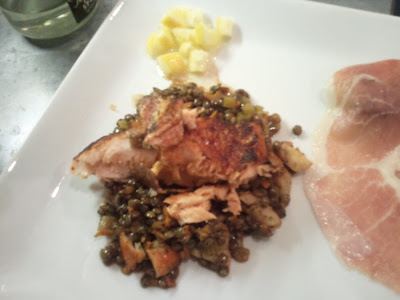
So, dinner Sunday was broiled miso salmon (Japanese) on a bed of lentils with chopped shrimp (French) with preserved lemon (Moroccan) with a slice of prosciutto resting atop 4 seasoned olives on the side (Italian).


(I also invented "salmon lardons." Basically, this is the crispy salmon skin sliced up and sprinkled over the finished dish.)


The lentil take longest. I made them in a very traditional way, sweating off half a chopped onion, a chopped stalk of celery, and a shredded carrot. I added a cup of dry lentils and stirred these in, bathing the lentils in the flavored sweet vegetables and residual oil. Then I added the warm stock and let this simmer for about 25 minutes.


I marinated the salmon in a little miso, shredded ginger, chopped shallot, soy sauce and sesame oil. To broil it, I first fired up a cast iron pan on the stovetop, seasoned it with a little vegetable oil, and placed the salmon in skin side down. After two minutes it went under the broiler for another five.


To assemble:


Mound some cooked lentils onto the middle of your whitest plate. Top with some cooked salmon, skin removed.


Spoon a bit of preserved lemon off to one side.


Add four-- not three, not five!-- olives to one corner of your square (yes, didn't I say square? Square is best) plate. Drape a lazy slice of delicious, sweet, salty prosciutto atop. Finish the dish with the salmon skin, which you've chopped up into little slices.


A lot going on-- sweet umaminess, salty/crispy, citrusy goodness. You'll never make this dish of course, but let it be an inspiration when you're looking to clear out the fridge.

Wait, that's not it. That's Thailand's gorgeous new P.M.


There it is.


Thai Salmon and Risotto

With a side of seared scallops with lime-cardamom dust, naturally.

This is a tasty dish, requiring a bit of work, but very nice for a dinner party. It can be largely prepared in advance, with ten minutes of work prior to serving. This is for four people.

Salmon Marinade:
Combine two chopped shallots or half an onion, two cloves chopped garlic, two tablespoons shredded ginger, juice of a lime or two, two tablespoons of brown sugar, 3 tablespoons of red curry paste, a teaspoon of fish sauce, 1/2 a teaspoon of sesame oil, and 4 tablespoons of vegetable oil, and mix really well.

Cut a pound of salmon into 4 filets and cover with about 1/2 the marinade. (Save the rest to add to the risotto and drizzle around the finished dish.)

Lime Cardamom dust
Crush a dozen little black cardamom seeds from inside the pod in a mortar and pestle; save a pinch for the risotto, below. Zest a lime. Mix the two in a small microwave-safe bowl and zap for 10 or 15 seconds at a time until the zest is dry. Sprinkle half of this dust on both sides of 8 sea scallops. (Save the rest for the finished dish.) Season them with salt and pepper too.

Risotto
This can be half-cooked ahead of your dinner party. Mix together a tablespoon of cumin, a teaspoon of sweet paprika, and the leftover pinch of cardamom dust. Heat 4 cups of seafood stock until it simmers and keep it aside. In a large saucepan or saute pan, saute a chopped shallot in a tablespoon of vegetable oil. Add a tablespoon or two of shredded ginger, two cloves crushed garlic, one teaspoon of red chili paste and the spice mix and saute for 30 seconds. Add one cup of short grain rice and stir to coat the grains in the flavor mixture. Start adding the stock, a ladle or two at a time, and let the rice simmer away. You can do this until about half the stock is absorbed, then stop. The risotto will be half-cooked but you can pick it up again just prior to serving dinner-- the salmon will be broiling and the scallops will be searing at the same time. But for now, go relax, have a drink, chill out with your guitar before your guests arrive.

Bringing it all together
After several cocktails with your guests, maybe a salad or something to start, preheat the broiler. Start heating the remaining fish stock and the turn on the heat under the risotto. Heat a saute pan. Open a can of coconut milk. Get ready to multi-task.

The rice will take longest, about 10 minutes so start that first. The scallops will sear about two minutes each side, and the salmon will broil in five minutes, so you'll start these when the rice nears completion. Or, wait til the rice is done before starting the seafood. It'll hold for a few minutes.

As the rice nears completion-- you're tasting as you're going, right?-- add about 1/3 can coconut milk and stir well. Add about a tablespoon of the leftover marinade and stir again. Lay the salmon filets on a foil-lined baking sheet and throw under the broiler. Add some bacon fat, duck fat, or vegetable oil to your hot saute pan and saute the scallops for about 2 minutes per side.


To assemble:
Mound some rice in the middle of each of four plates. Top with a piece of broiled salmon. Place two scallops next to this, which a small pinch of leftover "dust" next to the scallops. Drizzle a little marinade around the edge of the plate.

This would be nice to top with a little chopped cilantro and a couple of Thai basil leaves... a quarter lime would not be out of place. I'd drink a New Zealand sauvignon blanc or a crisp lager with this.

Friday

Grilled Cheese

Grilled cheese sandwiches. They've come a long way since two greasy slices of Wonderloaf surrounding molten American Cheese/food product. The two main ingredients (those would be "bread" and "cheese") offer so much variety as to create an infinity of delicious combinations. (Having said that, even a basic sandwich of whole wheat bread filled with shredded Cheddar is downright delicious.)

Let's all explore the universe of grilled cheese sandwiches. Let's get slightly adventurous with additional fillings (without drifting too far from the path of righteousness). Let's use that expensive cheese that ought to really only be served by itself, bereft of honey, balsamic vinegar, or chutney and nuts. Let's use bread that doesn't come in a plastic sleeve. Who's with me?

Basic grilled cheese:

Preheat oven to 350.

Preheat cast iron pan over medium heat.

Butter two slices of whole wheat bread.

Turn one slice over, butter side down (ew).

Cover this slice with lots of grated Cheddar.

Cover with second slice of buttered bread (butter side up).

Carefully transer the greasy mess to the hot pan.

After a couple of minutes, gently lift the bottom of the sandwich with a spatula; when it is golden brown, flip the sandwich and place the pan in the oven.

After approximately 5 minutes, remove the pan, remove the sandwich, cut it in half-- diagonally is nice-- and scarf down.

Thursday

Beans and Greens

I like canned beans. I like the mushy texture. I'm growing to like the viscous liquid they're packed in. Generally, I'd drain the beans and rinse them well. But when used judiciously, the liquid in the can thickens dishes and adds a pleasant creaminess.

Our garden is ripening. Pea pods have appeared, though they still resemble snow peas. A single green fruit adorns one tomato plant. Most of the spring greens have aged to the point of toughness and bitterness, though we can still pluck the occasional tender leaf. The beats are of varying size. Yesterday I thinned them, primarily to get the leaves, which I turned into beans and greens.

Saute half a chopped onion in olive oil.

Add some cleaned, chopped greens like beet greens, chard, kale (from which you've cut out the tough central stem). Use more than you think, they'll cook down significantly. Season well with salt and pepper.

After the greens reduce, about two minutes, add a few cloves of chopped garlic and half a can of white beans, with a little bean liquid. Add half a cup of chicken or vegetable stock or water, and a bit more salt. Add a pinch of red pepper flakes.

Cover and let cook on a low heat for about 15 minutes. Remove lid. If too moist, allow to simmer lidless for a few minutes.

Tuesday

Thai Beef Salad

We have big lettuce leaves available to us in our community garden. And cilantro, mint, chives and basil. Got me thinking of rolling and dipping things into sauces, as we did in Hoi An, Vietnam a couple of years ago. But spring rolls and banh xeo are beyond the commitment I was prepared to make on a Friday evening. The prep work alone would interfere with my ability to enjoy a cocktail.

A modified Thai Beef Salad would be a good compromise, and except for the beef, I had all the ingredients on hand-- or at least enough to approximate the dish.

Five minutes prep work, then you have a couple of hours to kill (read: drink) while the marinade works its flavor magic.

This is a great dish for a hot night, especially delicious when paired with cold lager.

1. Season your steak well S and P. I used sirloin, a mid-priced cut that grills well.

2. Make the marinade. Mix together:
one chopped shallot (or half an onion)
grated ginger, about the size of a ladyboy's thumb
two cloves minced garlic
juice of two limes
black pepper

Let this sit and stew for a few minutes while you replenish your drink.

Add:
four tablespoons vegetable oil
two tablespoons brown sugar
one or more tablespoons red curry paste (this is mild)
splash sesame oil (optional)
splash fish oil (optional)

3. Set half the marinade aside-- this will be the dipping sauce. Marinate the steak in the rest, for a minimum of two hours, preferable many more.

4. After a few cocktails, nonchalantly light your grill. Grill steak to MR, then let it rest for at least five minutes. Slice it and serve it with lettuce leaves and lots of fresh herbs. Roll up the meat and the herbs in the leaves and dip into the flavorful sauce. Don't wear your best shirt. In fact, eat naked.

Saturday

Sardines. Spinach. Beans.

Waistline. Winter. Widening. But it's all coming off. One day. Honest.

Couple of spoonfuls of yogurt for breakfast... I suppose lunch was vaguely Atkins like-- not that I espouse dieting except the "eat less exercise more" kind.


Anyway, it was very tasty, filling in a way that only lots of protein can fill you, and probably healthy as well-- though "healthy" comes last in my book. If something is unhealthy but tasty, eat it anyway if you enjoy it. The happiness it brings you outweighs the calories.

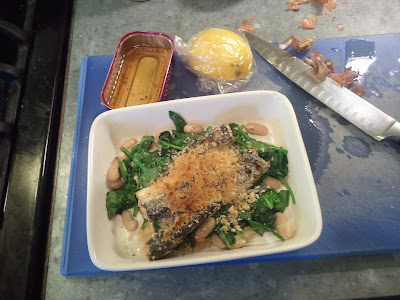
1. Pre-heat broiler. Open a can of sardines packed in olive oil. Drain, reserving the oil.

2. Saute a chopped shallot (or a bit of chopped onion) in a little of the oil. (Or lightly saute a finely chopped garlic clove for a few seconds until fragrant.)

3. Add half a bag of baby spinach and a few tablespoons of canned white beans to the pan and some salt and pepper and saute about a minute until just wilted.

4. Transfer spinach to oven-proof dish. Top with sardines. Top sardines with break crumbs, and drizzle the crumbs with a bit of the leftover oil.

5. Broil until just browned, about a minute. Add a squeeze of lemon and eat your way to thin.

I also baked a loaf of focaccia this morning and am now going to eat some with some cheese and a beer, nullifying any lightening effects of my earlier meals. Dinner out with friends at Elements, a restaurant known for its charcuterie... And tomorrow I'm determined to have spaghetti and meatballs.